Showing posts with label Wartime Healing. Show all posts

Wednesday, 25 July 2012

Duke of Wellington's West Riding Regiment in Healing

     With a long and distinguished history of service, in the American Wars of Independence, the Crimean War, and the Napoleonic Wars and more, it is surprising to learn that this famous regiment was once in Healing. But, indeed, according to some photographs from 1914, they were to be found within our village...

Whilst doing research at Grimsby's Reference Library, I came across these pictures tucked away inside a box:

Dated 1914, they show the regiment in Healing. From these, we may hazard a guess as to what they were doing here - the picture below shows a soldier leading a horse from a stable. I believe the regiment was looking for and gathering new recruits and/or horses for the war effort. 


They were also to be found within other local villages, such as Riby. The picture above is captioned as being taken in Pinney's Farm. We may therefore presume that the other pictures were taken in the same location. Below is an image of some of the higher ranks photographed with members of the Pinney household.
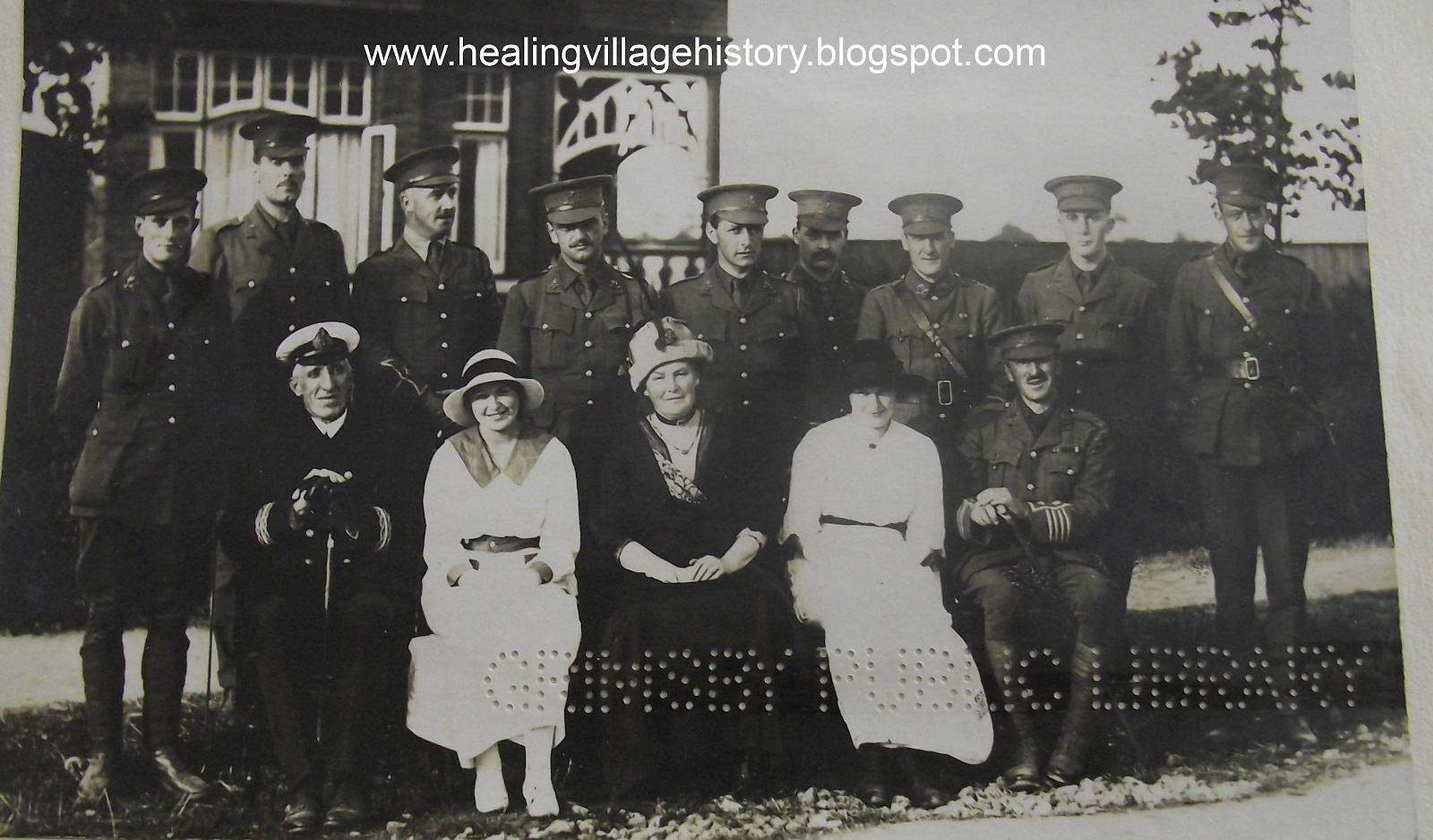
As well as this, we have an image taken in a (presumably nearby) field. 

And, for a final image, we have a picture of Lt Slingsby and Cpt Wright.

Lt. Anthony Edward King Slingsby was 26 when he was killed in Marske in July 1914

For more information, please see this post by Rod Collins here.
Regards,
James


Tuesday, 1 May 2012

Wells Road Air Raid Shelter in Healing

     Whilst hastily-constructed Anderson shelters were put up in gardens in Healing at the start of the Second World War, many people didn't have to go through the effort of building one. This is simply because the government paid for larger, stronger concrete shelters to be built, for the local people. Healing has an example of one of these of its own:

    Located on the road Riby, the air raid shelter on Wells Road is said to be a 'Stanton' shelter. This type in particular was located near airfields and military sites. Could this shelter then be connected to the Wells Road searchlight battery?
     The local people used this shelter to their advantage too, as they would come here during a raid for protection. If you lived at the other end of the village, there would be no time to flee here before the bombs started: you had to make do with your own corrugated-iron shelter! At one side of the small mound of earth covering the shelter is a large cncrete doorway, with wooden steps leading downwards...

There was simply no time for many people to pile down a ladder several feet in the air: a small stairway was much more convenient. Shown below is an image of the escape hatch, which could be used should one entrance become blocked.
Regards,
James

Saturday, 17 March 2012

ARP in Healing

During the Second World War, the Nazi menace attempted to blow the Allies into submission, by bombing civilian towns and cities. The attacks were devastating; even our own village, Healing, didn't escape attack.

To help injured civilians, clear bombed-out buildings, tell people to "put that light out!" and to boost morale, the Government set up the ARP - Air Raid Precautions. Immortalised by the TV programme Dad's Army, the ARP was set up in Healing on September 11th 1939, 10 days after the beginning of the war. This information is in the log-book, shown below:


Unfortunately the log-book does not tell us some things: firstly, where was the lookout post? 

Most days were quiet (on May 14th 1941, perhaps as a little joke, a warden writes 'All Quiet on the Healing Front'), with few bombs and little or no gunfire, but one night is recorded as being rather serious:

"Saturday May 11th [year?]. Bombs dropped on river bank between Grimsby and Immingham - probably some in Grimsby but not sure. Plane machine-gunned Wells Rd searchlights and its engine appeared to cut out over the village and was not heard again - officer from searchlights made enquiries as someone reported plane down at Healing with no confirmation [unreadable] to 05:00."

It turns out there was no plane crash in Healing, however, somewhere on Wells Rd is a bomb crater. I wonder where it is?

These men put out fires, rescued people from burning buildings, and, in doing all of this, put their own lives at risk. After the war, the group continued as the 'Fire Guard', and helped with the coronation of Queen Elizabeth in 1952. Soon after this, they were closed down.

Lest We Forget,
James


Saturday, 25 February 2012

Healing's War Grave - Cyril Porri

As I was looking through the graveyard at Healing church today, I found another war grave. I was surprised by this, as I thought I would quickly find all the war graves in such a small churchyard. The reason for this is that the CWGC cleans and maintains the graves, so they are usually bright white, often with a little red poppy.
As you can see, this one is not, and is covered in dirt and mould. The inscription reads:

"Group Captain
CYRIL PORRI
Observer
Royal Air Force
(Retired)
23rd May 1950, Age 57."

This would explain why he is not listed with the CWGC (as he was retired), however, why he was buried with a military headstone. Searching through archives and records, I've found some newspaper clippings of Group Captain Porri's rise through the ranks:
THE LONDON GAZETTE, 1 JANUARY, 1929.

Note that the same person, Frederic Stammers, O.B.E is listed with Porri:

THE LONDON GAZETTE, 31 DECEMBER, 1935

Can we safely assume the two men were both friends? 
Having checked the census records, we can see that Porri was born in 1893, was 18 at the time of the 1911 census, and he lived in Grimsby. 

Lest we forget,
James

Wednesday, 1 February 2012

Healing Cenotaph

Like most villages, Healing has a war memorial. A large stone pillar bearing a cross and adorned with wreaths and poppies, the cenotaph guards the entrance to The Avenue.
Each year, on Remembrance Sunday, the residents of Healing gather round to pay their respects to Healing's fallen men.
At this time of year, the cenotaph looks at its best. Remembrance Sunday has renewed the poppies and the memories. 
The men of Healing have fallen in both world wars. For the First World War, the list of names is as follows:

"Fred Garrott (?), 6th Lincs.
Arthur Chapman, Civil Service Rifles.
William Cockett, 1/5th Lincs.
John Epton, 94th Battalion M.G.C. (?).
Bateman Fowler, N.M.B, R.F.A.
Albert E. Lammin, 8th Suffolk Cyclists.
Ernest Nightingale, N.M.B, R.F.A.
Charles S. Pinney, 44 Battalion A.I.F.
Joseph Pinney, 3rd Lincs.
Harry Rudkin, 10th Lincs.
Charles Waller, Middlesex Regiment."

Of course, the centotaph remembers the casualties from both world wars. The list for the Second World War is as follows:

"Thomas H. Cox, R.A.F.V.R.
Joseph Gathergood, R.N.
Neville S. Peers, R.C.S.
Leslie Pycock, Beds and Herts."

Lest We Forget,
James


Sunday, 8 January 2012

Healing Searchlight Battery

War always seems to usher in a new generation of innovative technology, and the Second World War was no different. A new weapon against air raids was the searchlight, which lit up the undersides of enemy aircraft so AA gunners could see their target. 
Healing had a searchlight battery of its own, which was located on Wells Rd. It's easy to see why a searchlight battery would be located there: there's a slight hill, good visibility, conveniently close to the HAA gun emplacement at Stallingborough and a concrete public air raid shelter (future article alert!) a short distance away. There aren't many visible remains left, but I believe I have found an important piece of evidence:
A concrete plinth, which may have been used to stop the searchlight from falling into the mud. Below, there is a possible drainage hole:

As you can see, it's blocked up with weeds now. The idea is that the rain would run down into the soil via these holes, however, I couldn't see to the bottom, so I cannot confirm this. The plinth is covered in moss now, but if you scrape some of it away...
 Very clearly concrete.

Regards,
James 

Tuesday, 27 December 2011

Healing's War Grave - John Bates

The Second World War seemed to affect just about everyone everywhere, and Healing is no exception. Many of the brave men and women who answered their country's call never returned home, and this man is one of them.
In the peace and tranquility of Healing churchyard, there is a reminder of the time our country was at war. A war grave, that of John Bates. It is a simple white headstone, recording only the name, service number and date of death.
"1165087 Corporal
J Bates
Royal Air Force
11th March 1945"

John Bates was in the RAF Volunteer Reserve. His age, according to the Commonwealth War Graves Commission, is 'unknown'. But, there is a mystery. Healing cenotaph does not record J Bates as one of the fallen men of Healing. So, why was he buried in Healing churchyard? He can't have crashed nearby - there are no records for crash sites near Healing. 

For those wishing to pay their respects to this man, he is buried in row 2, grave 18 in Healing churchyard.

I found this whilst researching Cpl Bates:

"Cpl John Bates (RAF), 324 Hainton Avenue, died"

Could this be the John Bates we are looking for? I assume so; the website was all about Grimsby's fallen servicemen and women. 

Looking at the website, most of the deaths seem to mention 'killed' or 'killed in action', rather than 'died'. Could we then assume that he died of natural causes than being killed in action?

As well as that, I have found the death register for him (Jan, Feb, Mar 1945). He was 33 when he died:


Lest We Forget,
James

Friday, 25 November 2011

Civil Defence Corps Training Ground

As I was pouring over my collection of Healing maps, I discovered something I had never heard of before - the Civil Defence Corps - and they were training here in Healing! 


The above map shows the training ground - it is on what is now Poplar Park, specifically where the tennis courts. Wikipedia tells me that the Civil Defence Corps were active during the Cold War, and their aim was to assist civilians in the aftermath of a nuclear attack. They wore dark blue suits with berets. As I mentioned before, this site is not mentioned in any of my books, so there is no evidence of what occured here.


Thursday, 3 November 2011

Healing Manor Air Raid Shelter

In the grounds of Healing Manor lies an important piece of Healing's WWII history - an old air raid shelter, perhaps used by Viscount Portman himself. It is located in the large medieval moat, and it is quite possible that Gerald Burkely Portman, the seventh Viscount Portman took cover in it during the air raids.
However, the shelter could be military-made as the Scottish Horse regiment took over the manor during the war, and Viscount Portman and his wife moved into 20, Fords Avenue. The above picture shows that someone has been strippng wire out of it. The shelter is made out of reinforced concrete and at the other end is an escape door, leading out onto the Manor lawn. 

I hope you find all this of interest,
James