Sunday, 2 September 2012
Healing Heritage Weekend
Hello everybody,
Just a quick note to show you the poster for the Healing Heritage Weekend, which takes place on the 8th and 9th September in Healing Church.
Displays by: Friends of Healing Moated Settlement, St Peter St Paul Church, Healing Wesleyan Methodist Church, A Healing House. Guided tours of the church. Heritage walks around Healing and surrounding area. Treasure Hunt. Refreshments.
Heritage walks leave at 10.30am, 1pm and 2.30pm. No need to book. Depart and finish
at sundial outside main doors. Please dress suitably. Some of the walk is not suitable for
pushchairs or wheelchairs.
Walk 1 explores the village and Walk 2 explores the Manor and fields.
James

Wednesday, 25 July 2012
Duke of Wellington's West Riding Regiment in Healing
With a long and distinguished history of service, in the American Wars of Independence, the Crimean War, and the Napoleonic Wars and more, it is surprising to learn that this famous regiment was once in Healing. But, indeed, according to some photographs from 1914, they were to be found within our village...
Whilst doing research at Grimsby's Reference Library, I came across these pictures tucked away inside a box:


Whilst doing research at Grimsby's Reference Library, I came across these pictures tucked away inside a box:

Dated 1914, they show the regiment in Healing. From these, we may hazard a guess as to what they were doing here - the picture below shows a soldier leading a horse from a stable. I believe the regiment was looking for and gathering new recruits and/or horses for the war effort.

They were also to be found within other local villages, such as Riby. The picture above is captioned as being taken in Pinney's Farm. We may therefore presume that the other pictures were taken in the same location. Below is an image of some of the higher ranks photographed with members of the Pinney household.
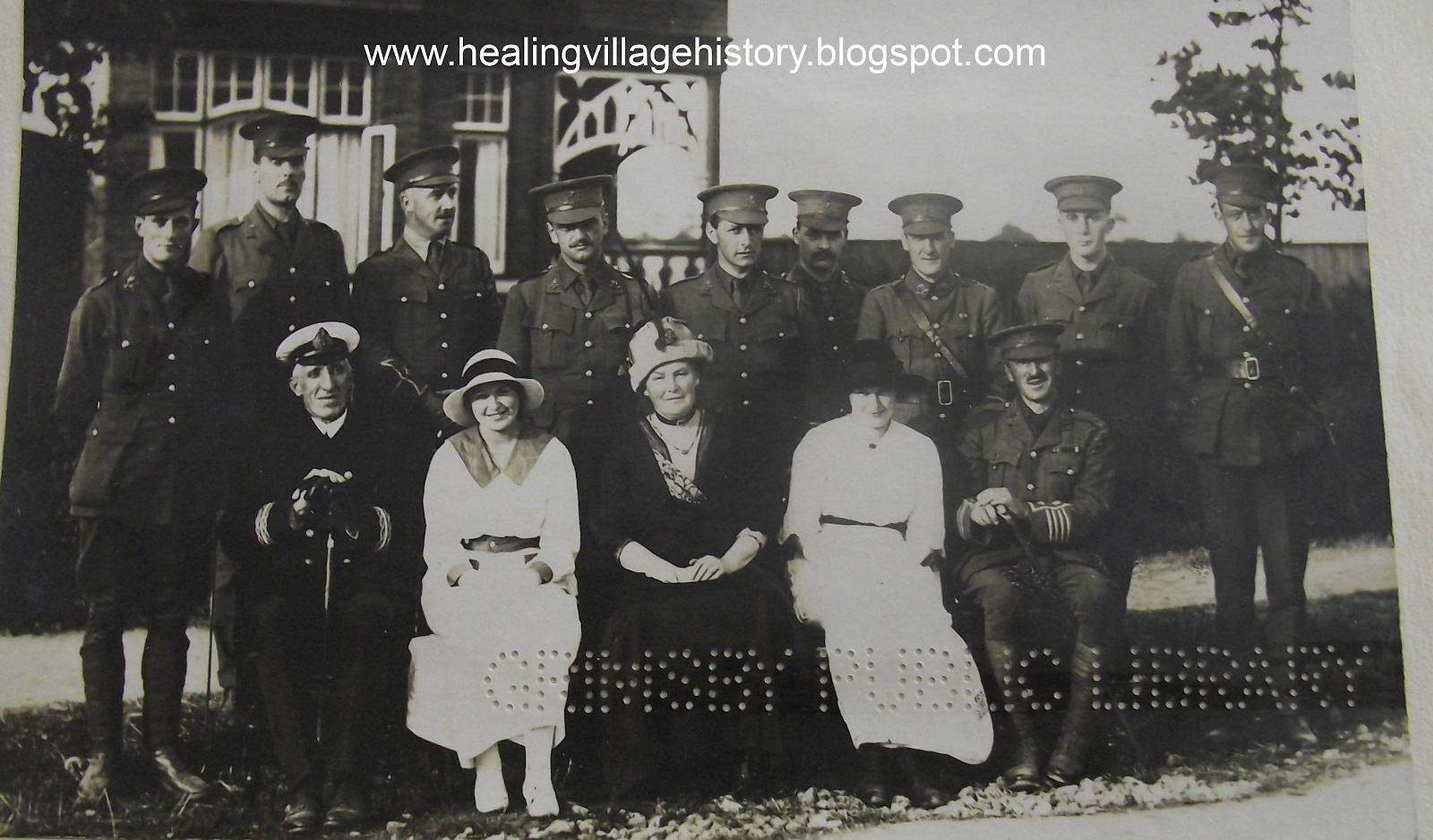
As well as this, we have an image taken in a (presumably nearby) field.

And, for a final image, we have a picture of Lt Slingsby and Cpt Wright.

Lt. Anthony Edward King Slingsby was 26 when he was killed in Marske in July 1914
For more information, please see this post by Rod Collins here.
Regards,
James
Tuesday, 5 June 2012
Scouting in Healing
Whilst rummaging through some papers in the 'History of Healing' cabinet in the church, I found an extremely interesting document, entitled 'Scouting in Healing'.
The first scout troop in Healing was formed in about 1920, by scoutmaster Alfred Robins and assistant Sidney Burgess. The group initially consisted of 21 boys, later increasing to 28 boys and 4 patrols. The troop was particularly active, publishing a monthly magazine and provided a guard of honour at the war memorial on Remembrance Day. The headquarters were based in an ex-army hut (purchased from the searchlight battery) on land belonging to the water company.
The troop continued to flourish until the death of Mr. Robins, when it began to decline for lack of leaders. It was then that the district commissioner, Captain Joules, took over with the assistance of Tom Clark and Bill Boswell as assistant scouters. At this time, the scout hut had to be sold, and the troop was moved to the loft above the garage of Mr. Ernest Kirman. During the war, the troop had to be closed down due to lack of leaders.
In 1946, Colonel John Wintringham of Humberston approved re-forming the troop, this time with Tom Clark and Murch Winship in the hut at the British Legion Field. This land was given by Lord Portman. Some of the boys who attended the scouts were Ronald Dye, Norman Chatburn, and Barry Clark.
Afterwards, there was another move, this time back into the hut near the searchlight battery. For many years, this was the scout headquarters, until 1951, when Tom Clark moved out, meaning it was difficult to find scout leaders.
Regards,
James
The first scout troop in Healing was formed in about 1920, by scoutmaster Alfred Robins and assistant Sidney Burgess. The group initially consisted of 21 boys, later increasing to 28 boys and 4 patrols. The troop was particularly active, publishing a monthly magazine and provided a guard of honour at the war memorial on Remembrance Day. The headquarters were based in an ex-army hut (purchased from the searchlight battery) on land belonging to the water company.
The troop continued to flourish until the death of Mr. Robins, when it began to decline for lack of leaders. It was then that the district commissioner, Captain Joules, took over with the assistance of Tom Clark and Bill Boswell as assistant scouters. At this time, the scout hut had to be sold, and the troop was moved to the loft above the garage of Mr. Ernest Kirman. During the war, the troop had to be closed down due to lack of leaders.
In 1946, Colonel John Wintringham of Humberston approved re-forming the troop, this time with Tom Clark and Murch Winship in the hut at the British Legion Field. This land was given by Lord Portman. Some of the boys who attended the scouts were Ronald Dye, Norman Chatburn, and Barry Clark.
Afterwards, there was another move, this time back into the hut near the searchlight battery. For many years, this was the scout headquarters, until 1951, when Tom Clark moved out, meaning it was difficult to find scout leaders.
Regards,
James
Saturday, 12 May 2012
Healing Manor For Sale
After some unfortunate history recently, Healing Manor has been put on the market, at a cost of £650,000. I personally think that this is great news - to have over one thousand years of well-preserved history on the brink of destruction in just a few years is absolutely awful. I hope the new owner takes great care of this most iconic piece of Healing's history.
Best of luck to the future owner,
James
For more information, please see here.
Best of luck to the future owner,
James
For more information, please see here.
Tuesday, 1 May 2012
Wells Road Air Raid Shelter in Healing
Whilst hastily-constructed Anderson shelters were put up in gardens in Healing at the start of the Second World War, many people didn't have to go through the effort of building one. This is simply because the government paid for larger, stronger concrete shelters to be built, for the local people. Healing has an example of one of these of its own:
 Located on the road Riby, the air raid shelter on Wells Road is said to be a 'Stanton' shelter. This type in particular was located near airfields and military sites. Could this shelter then be connected to the Wells Road searchlight battery?
The local people used this shelter to their advantage too, as they would come here during a raid for protection. If you lived at the other end of the village, there would be no time to flee here before the bombs started: you had to make do with your own corrugated-iron shelter! At one side of the small mound of earth covering the shelter is a large cncrete doorway, with wooden steps leading downwards...
 There was simply no time for many people to pile down a ladder several feet in the air: a small stairway was much more convenient. Shown below is an image of the escape hatch, which could be used should one entrance become blocked.
Regards,
James

The local people used this shelter to their advantage too, as they would come here during a raid for protection. If you lived at the other end of the village, there would be no time to flee here before the bombs started: you had to make do with your own corrugated-iron shelter! At one side of the small mound of earth covering the shelter is a large cncrete doorway, with wooden steps leading downwards...

Regards,
James
Subscribe to:
Posts (Atom)